素人ヤドリバエ屋の庵室
a hermitage of an amateur Tachinidist
1.What's Tachinidae?
Tachinidae is, more precisely,
Family Tachinidae, Superfamily Oestroidea, Subsection Calyptratae, Section Schizophora, Clade Eremoneura, Infraorder Muscomorpha, Order Diptera, Insecta.
It is one of the largest families in Diptera (flies), with no fewer than 8,592 species known worldwide as of 2020 (O’Hara et al., 2020).
Most Tachinid species are parasitoids...
they invade their host's body, and make it their home or refuge.
They are notoriously well-known among caterpillar lovers. When you raise a caterpillar, it may suddenly die, and instead, something that looks like a red bean is lying nearby. After a while, flies emerge from it. This must be a nightmare for caterpillar breeders. And that fly often belongs to Tachinidae.
During their larval stage, they feed on their host's body. Although you may think that tachinid flies usually parasitize caterpillars, there are also species - such as Meigenia, Istocheta, and Anthomyiopsis - whose hosts are Coleoptera, and others - such as Phasia and Ectophasia - whose hosts are Hemiptera. Some genera, such as Phorocerosoma and Exorista, include species whose hosts are Orthoptera or Mantodea.
Generalists also exist. For instance, Bessa parallela, which is common in Tokyo, can parasitize Coleoptera, Lepidoptera, and Hymenoptera. This is quite an unusual case. "The ability to parasitize" means "the ability to tactically evade its host's immune system." It is fascinating how Bessa parallela evade all the immune system of Coleoptera, Lepidoptera, and Hymenoptera.
* Please note that not only tachinidae species are parasitoid among Diptera. Some parasitoid species also exist in other families, such as Sarcophagidae and Phoridae...
Such tachinid flies are relatvely similar in appearance to large flies, such as Muscidae and Sarcophagidae, which often emerge inside our house. However, many tachinids are characterized by their sharp and robust bristles on the abdomen.
※There are also species with weak or no bristles on the abdomen, especially in the subfamily Phasiinae.
The body length is often large compared to other flies, but some can be small, around 2-3 millimeters. The body colour also varies greatly among species from grey to metallic green. Sarcophagids are often mistaken for Tachinids, but they typically have three distinct black longitudinal lines on their scutum. Additionally, their abdomens tend to have a tessellated pattern, making them distinguishable from tachinids once you become familiar with them.
Such tachinid flies are relatvely similar in appearance to large flies, such as Muscidae and Sarcophagidae, which often emerge inside our house. However, many tachinids are characterized by their sharp and robust bristles on the abdomen.
※There are also species with weak or no bristles on the abdomen, especially in the subfamily Phasiinae.
The body length is often large compared to other flies, but some can be small, around 2-3 millimeters. The body colour also varies greatly among species from grey to metallic green. Sarcophagids are often mistaken for Tachinids, but they typically have three distinct black longitudinal lines on their scutum. Additionally, their abdomens tend to have a tessellated pattern, making them distinguishable from tachinids once you become familiar with them.

↑ Tachina amurensis
2. Identifying Tachinidae
(not translated yet, sorry)
Taxonomic research on Tachinidae is lagging behind compared to that of many other insect groups. Here are four possible reasons below.
①Only a handful of people are interested in Tachinidae.
②Identifying them requires advanced, highly specialized knowledge.
③The process of identification takes much time and also demanding.
④There's too little previous study.
Starting with point ① - the biggest issue is that Tachinidae-lovers are extremely niche. In the first place,Diptera-lovers in general are also very rare.
Among insects, there are five major families, known for having particularly big number of species:
a) Coleoptera
b) Lepidoptera
c) Hymenoptera
d) Hemiptera
e) Diptera
Needless to say that Diptera is probably the most unpopular of these five. And among dipterists, those who specialize in Tachinidae are an even smaller minority. This would be the biggest reasons why Tachinidae research is still so limited.
Next, let's move onto points ② and ③. When you identify a butterfly, a large beetle, or a dragonfly, you can often tell the species easily by just looking at its color pattern, body shape, or size. However, this is not the case with Tachinidae. It is so risky—or often impossible—to identify by just examining such traits —because so many species look almost identical to each other. On top of that, some species show an abundant intraspecific variation.
So, what traits do we use to identify tachinids? The answer is... the number, position, length, and even the angle of "bristles" on their bodies —plus the shape of their genitalia. Actually, you might be surprised to hear this, but each one of the "bristles" on the body of a tachinid is classified and named!

↑Shown above is only the morphological terms of head in lateral view. These are only the handful of terms among numerous.
You need to be familiar with all of these morphological terms if identify. This is why the identification of Tachinidae is difficult. And these terms can often be replaced with other terms according to the age when the paper was written, and sometimes be written in abbreviation and that abbr. has a little variation among each papers. Reading taxonomical paper of Tachinidae is quite a hard work.
When identifying, you need to handle a binocular stereo microscope and observe such "bristles" in detail one by one. But sometimes, bristles can often be fallen off or broken, or in rare cases, even its number can change according to individual mutations. These cases sometimes make its identification drastically difficult.
Examining the bristle arrangement is fundamental, but sometimes tricky in cases explained above. Also, there's a possibility that it is an undescribed or encryptic species whose appearances are almost the same with that of known ones. Therefore, we also refer to the shape of its genitalia.
Genitalia differs according to species. Basically, there are distinctive characteristics in male genitalia, so we usually identify by its male genitalia. Male genitalia consists of cercus, surstylus, phallus and so on. On the other hand, female genitalia can also sometimes be the key for identification, with slight differences among species. But the characteristics of female genitalia are usually not described in papers, and the interspecies differences are often very faint. Female genitalia means ovipositor, and so on.
When observing its male terminalia, we soak it to KOH (or lactic acid as substitute), and then dissect it in glycerine. That's a quite hard process. Even though handling them prudently, me, like an inexpert person, sometimes damage them. I need to practice more, anyway.

↑A sketch of male genitalia, Eumea linearicornis (Zetterstedt)

↑The male terminalia of Compsilura concinnata (Meigen)
Then, can we identify tachinidae easily if we observe their male genitalia? -The answer is "no." It is not wrong that their male genitalia help us identify them more correctly and strictly. At the same time, however, no one knows if that identification is correct or not (unless we conduct a DNA sequencing).
You will come across the difficulty in identifying again and again, even if you examine their male genitalia. You can find out why when seeing some figures of genitalia of related species on literatures. We often face figures of two different species, that are alike as two peas in a pod! The only way to know the truth is to compare the actual materials under a microscope, or they may not be understandable even after seeing them. In addition to these things above, the shape of genitalia greatly changes according to its condition and to the angle we observe them. We always have to think about it. That makes identification of Tachinidae even more difficult.
The size of their eggs is also one contributing key when identifying. For example, genus Carcelia and genus Carceliella look very similar. They both has large eyes with dense hairs and hind coxae with setulae posterodorsally. However, while the eggs of Carcelia is macrotype, which means a usual size, the eggs of Carceliella is microtype. At this moment, these two genera are classified into other tribes. (Tachinid flies with microtype eggs have the strategy of scattering significant amounts of eggs on leaves and parasitizing the caterpillar that ate eggs, instead of ovipositing eggs on a host directly.)
Regarding the more difficult genera, such as genus Blepharipa, the identification based on external characteristics is sometimes impossible. Related species with the same appearance can divided merely on the difference of their host, or on the difference of their DNA.
・・・
There are so many species in family Tachinidae, so just identifying its genus can be a heavy task - we use an identification key with 549 couplets! (if in palaearctic region.)
I can tell it would take some hours if those who are not accustomed to handle it use this identification key. In addition, such an identification key can include wrong or outdated information, and it is also a source of trouble.
There are almost no literature written in Japanese, so we always read academic papers or book written in English, Chinese, Russian, German, and so on...it can be sometimes written in Italian or in French, as well.Today, translation tools are widely available on the Internet. However, of course, they do not translate jargons correctly. It is good to have some knowledge on some languages when starting to take a step in the taxonomy of Tachinidae.

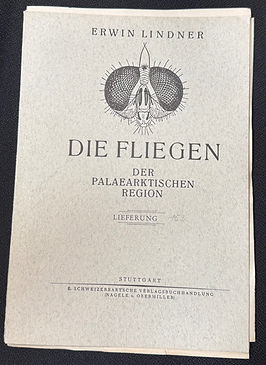

↑Literature written in Chinese
↑Literature written in German
↑Literature written in Russian